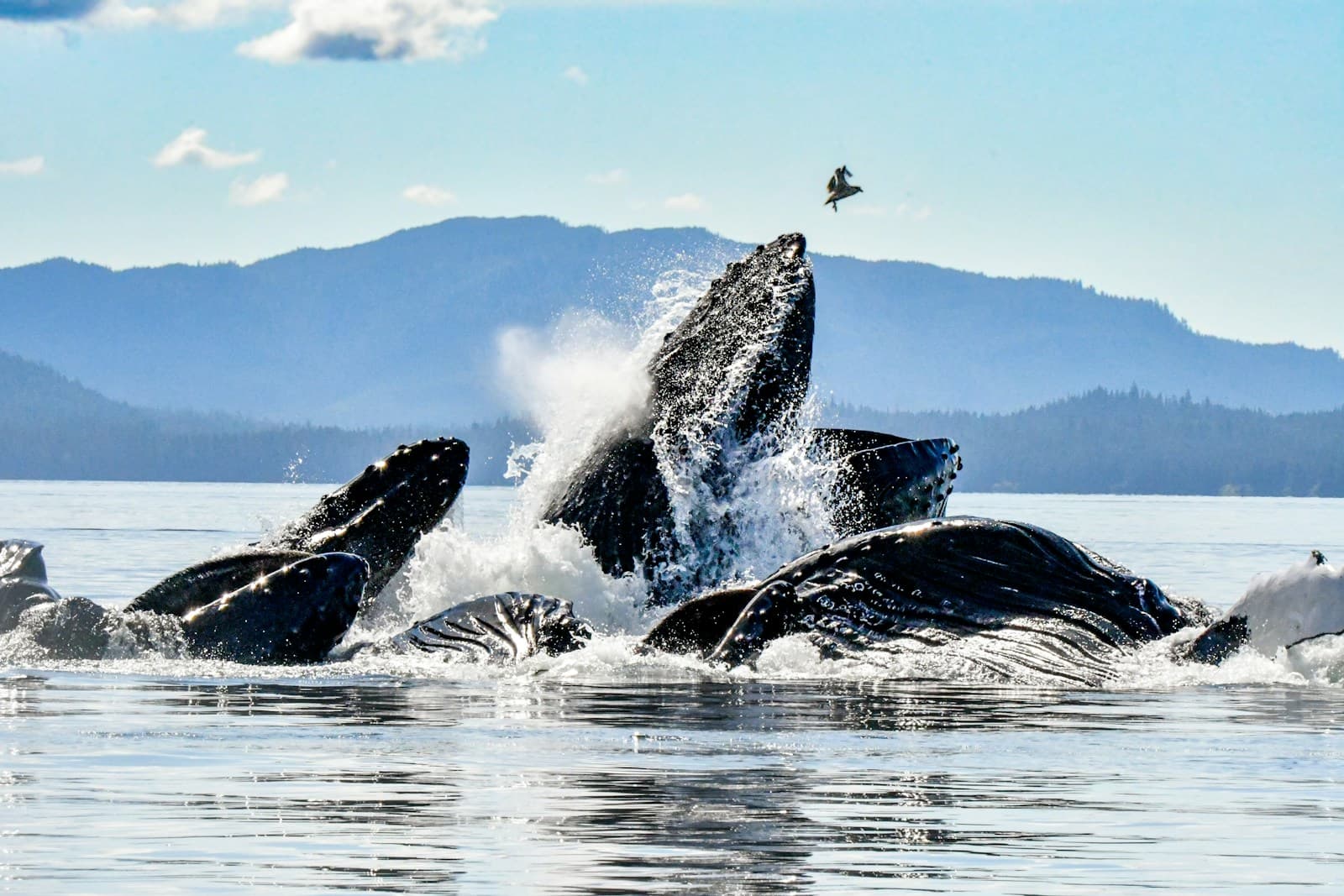
Every year, about 40,000 humpback whales migrate up the east coast of Australia from Antarctica to the tropical waters off north Queensland to calve, then back down again with their babies. It is one of the largest mammal migrations on Earth and it happens within sight of most of the coastal towns on the route.
The trick is knowing which week they're passing your town. The northern migration (May to August) is different from the southern return (August to November), and the windows shift by about three weeks for every 1,000 km of coast. Below is what that actually looks like, town by town.
The two migrations
Northern migration: May to August. Whales move north looking for warm calving water. They are purposeful, travelling in pods of two to six, often staying further offshore. You'll see blows, tail slaps, and occasional breaches. They don't hang around.
Southern migration: August to November. Whales return south with calves. They are slower, closer to shore, more playful, and more likely to approach boats. This is the better viewing window if you get to choose, especially September and October.
Town-by-town timing
Eden (far south NSW)
Northern: late Jun to early Aug. Southern: early Sep to late Oct. Eden sits on a deep-water coastline and whales often come remarkably close to shore. Twofold Bay is one of the best land-based viewing spots in the country. The historic whaling museum at the top of the bluff gives you elevation. Boat tours run out of Eden from Sep to Nov predominantly.
Sydney
Northern: late May to late Jul. Southern: mid Sep to late Oct. Sydney has an enormous whale-watching operation out of Circular Quay and Darling Harbour. North Head and South Head are the best land viewpoints. The migration path is typically 1 to 3 km offshore, so a boat trip significantly out-performs the headlands for sightings.
Port Stephens
Northern: early Jun to late Jul. Southern: mid Sep to early Nov. Port Stephens has resident bottlenose dolphins year-round plus seasonal humpbacks, which makes it a strong bet if your dates are flexible. Tomaree Head walk is the best land viewpoint.
Byron Bay
Northern: mid Jun to early Aug. Southern: mid Sep to early Nov. Cape Byron lighthouse is the most famous whale-watching vantage on the east coast and it earns it. You're standing at the easternmost point of the mainland, 100 m above the water, and the whales pass within 500 m. Go at first light. Tour boats run out of Byron from Jun to Nov but the walk to the lighthouse is the honest pick and it's free.
Gold Coast and Brisbane
Northern: mid Jun to early Aug. Southern: mid Sep to early Nov. Point Danger at Coolangatta and the Gold Coast Seaway are solid land-based options. Tangalooma on Moreton Island runs combined whale-and-dolphin trips in winter.
Hervey Bay (Queensland)
This is the one. Hervey Bay sits in the sheltered waters between Fraser Island (K'gari) and the mainland. From early August to late October, whales stop here on the southern migration to rest with their calves before the next leg. The water is calm, the whales are curious, and this is where humpback-boat interactions happen. Whales actively approaching vessels. Boat operators here are regulated to stay 100 m off but the whales don't read the rules.
If you can only see whales once in your life, make it Hervey Bay between mid-August and mid-October. Half-day tours from $140. Full-day and multi-day charters available.
The Whitsundays
Northern: early Jul to late Aug. Southern: mid Aug to mid Oct. Whitsunday whale-watching is often combined with sailing trips. The calves are small and the water is extraordinary. You'll remember the backdrop as much as the whales.
Cairns and the Far North
Northern: late Jul to early Sep. Southern: early Aug to late Sep (shortest window). This is the turnaround zone. Whales calve here and immediately start south. Your window is tight, maybe six weeks, and you're looking for mothers with young calves. Numbers are lower than further south but calf sightings are common.
Additional note: southern right whales
Almost everything above is humpbacks. Southern right whales also pass; fewer numbers (a few hundred on the east coast vs 40,000 humpbacks), slower, blacker, no dorsal fin. Your best chance of seeing one is in winter off the south coast of NSW and Victoria (Logans Beach in Warrnambool on the Great Ocean Road is the most reliable spot in Australia for southern rights). On the east coast proper they are a rare bonus, not a reliable sighting.
Land vs boat: which is better?
Boat. You'll see more animals, closer, for longer. Operators know where the pods are, they can move. A half-day boat tour in Hervey Bay or Byron in peak season will almost always produce multiple sighting events.
Land. Free, weather-independent for cancellations, and in the right spots (Cape Byron, Tomaree Head, Eden bluff) genuinely excellent. Bring binoculars (8x or 10x) and stand still. Dawn and late afternoon are best.
If budget is limited, spend an hour on a headland with a thermos before you book a boat. You might not need the boat at all.
Booking tips
- Peak windows book out. Hervey Bay in September is the busiest whale-watching market on the east coast. Book two weeks ahead.
- Morning tours are better than afternoon. Seas are calmer and whales are more active.
- Operators with marine biologists on board are worth the extra $20. You'll understand what you're looking at.
- Full refund policies for no-sightings. Most east coast operators in peak season have a "whale guarantee": free rebook if no sightings. Don't book one that doesn't.
:::ask-serge Ask Serge about: "I'm in Byron in late September. Do I do the lighthouse walk or a boat, and which boat?" :::
One last thing
The blow, the misty vertical spray when a whale surfaces, is visible from much further than the whale itself. On a calm day you can see a humpback blow from 4 km away. That's what you're scanning for from a headland. Once you spot a blow, stay on it. The animal will surface again in roughly seven minutes.